
The Difference Between Additive and Subtractive Colors
What are primary colors?
Primary colors are a small set of basic colorants (paints or inks) or colored lights that can be combined to create a broad range of other colors. That range is called a gamut. Within a set, no primary can be made by mixing the others.
The two most common color-mixing models are the additive primaries (red, green and blue, or RGB) and the subtractive primaries (cyan, magenta and yellow, or CMY). Many art classes still teach red, yellow and blue (RYB) as the primary colors of paint. RYB is an older, more limited model. It works for painting, but it can’t mix as wide a range of clean, bright colors as CMY.
Why three? Most people are trichromats. The retina has three types of cone cells, most sensitive to short (blue), medium (green) and long (yellow-red) wavelengths of light. Because our color vision has three channels, at least three primaries are needed to reproduce a meaningful portion of the colors we can see. Some people are dichromats, with only two working types of cones. This is the most common cause of color blindness, such as red–green color blindness.
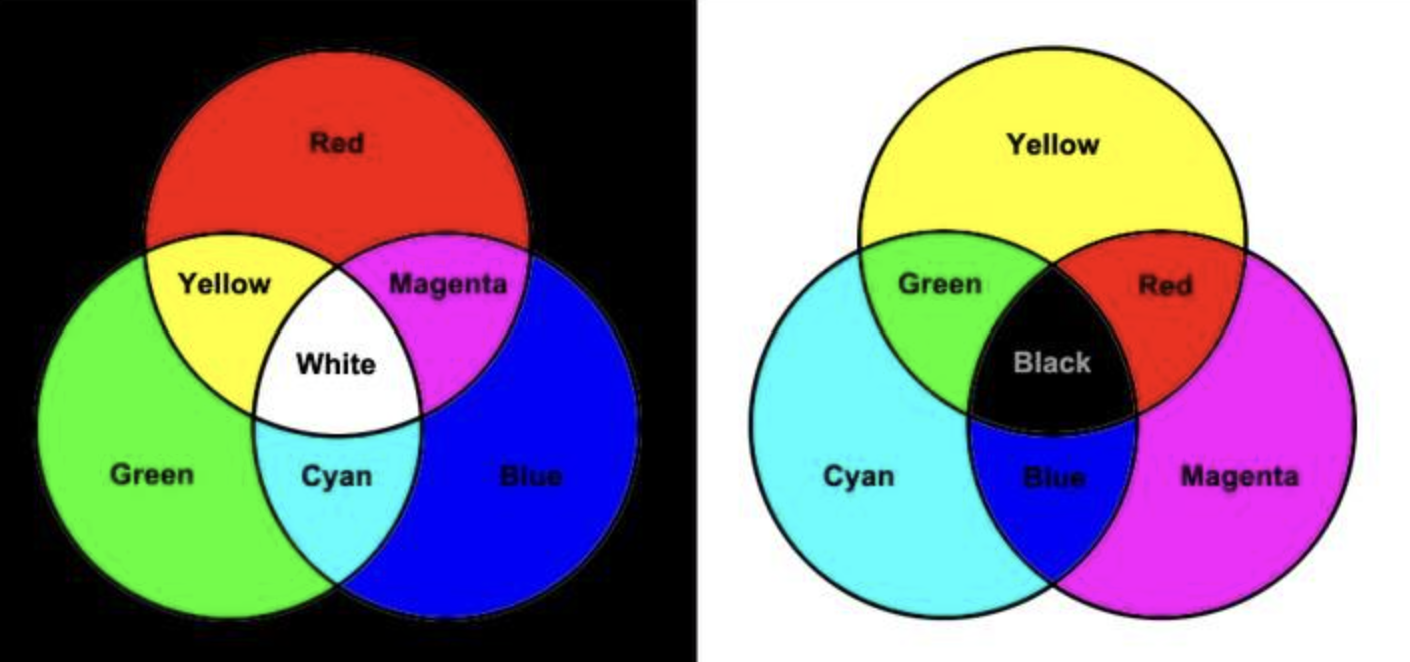
Figure 1 shows how each set of primaries mixes.
How we see color
Let’s look at how additive and subtractive mixing work in the physical world. First, we need to know why we see color at all. Most objects don’t make their own light. They reflect some wavelengths of the light that falls on them and absorb the rest. The reflected light enters our eyes, the cone cells in the retina respond, and the brain interprets those signals as a color.
Green leaves, for example, look green because the chlorophyll in them absorbs most of the red and blue light and reflects more of the green light. A surface that absorbs nearly all visible light looks black. A surface that reflects nearly all visible wavelengths evenly and diffusely looks white. (A black hole is black for a different reason: its gravity is so strong that not even light can escape it.)
Next, let’s compare two ways of making a picture of green leaves: painting them, and photographing them and viewing the photo on a screen.
Painting a green leaf (subtractive)
To paint green leaves, we use green paint, or we mix cyan and yellow paint to make green. Green paint reflects mostly green light and absorbs most of the other colors. When that reflected green light reaches the cones in our retina, we see green.
Photographing a green leaf (camera and screen)
A camera’s CMOS image sensor works differently. Each pixel’s photodiode measures only how much light arrives, not what color it is. To capture color, the sensor is covered with a mosaic of tiny red, green and blue filters (CFAs), usually arranged in a Bayer pattern (half green, a quarter red and a quarter blue, such as RGGB). Light reflected from the leaves passes through these filters. Each photodiode converts the light it receives into an electrical signal, which is then digitized into a number, such as a value from 0 to 255 for an 8-bit pixel.
Under the green filters, the values are high (say, around 200), while under the red and blue filters they are low. A step called demosaicing then estimates the full red, green and blue values at every pixel. The camera’s image signal processor (ISP) also adjusts white balance, color, brightness and Gamma correction.
When we view the photo, the screen reproduces each pixel with tiny red, green and blue subpixels that emit light. For our leaf, the green subpixels glow brightly and the red and blue ones stay dim. The emitted light adds together in our eyes. That is additive color mixing.
In short: in a painting, we see green because the paint reflects green light. In a photo on a screen, the camera measures the green light through its color filters, and the display recreates it by emitting green light.
Mixing paint: why cyan + yellow = green
Now let’s see how mixing works in the subtractive system, using cyan and yellow paint.
Cyan paint reflects blue light (around 450 nm) and green light (around 550 nm), and absorbs red light. Yellow paint reflects green light (around 550 nm) and red light (around 650 nm), and absorbs blue light. When the two paints are mixed, the cyan removes the red and the yellow removes the blue. Only green light is reflected by both, so the mixture looks green.
That is why this system is called subtractive: each paint subtracts part of the light. The more paints we mix, the more light is absorbed, and the darker the mixture becomes.
Fun fact: yellow light can be a single wavelength (about 580 nm) or a mix of red and green light. Our eyes can’t tell the difference, which is exactly why a screen can show yellow using only red and green subpixels.
Mixing paint vs. mixing light
Table 1 shows how to make common colors in paint and in light. Notice that the two systems mirror each other: the primary colors of light mix to make the primary colors of paint, and vice versa.
Table 1. How to mix colors in paint (subtractive) and in light (additive).
| Target color | Paint / pigment (subtractive) | Light (additive) |
|---|---|---|
| Green | Cyan + yellow (traditional RYB: blue + yellow) | A primary color of light |
| Orange | Yellow + a little magenta (RYB: red + yellow) | Red + some green (less green than for yellow) |
| Purple / violet | Cyan + magenta, with extra magenta (RYB: red + blue) | Blue + some red (equal red and blue make magenta) |
| Yellow | A primary color of paint | Red + green |
| Red | Magenta + yellow (a primary only in the traditional RYB model) | A primary color of light |
| Blue | Cyan + magenta (a primary only in the traditional RYB model) | A primary color of light |
Summary
Primary colors of light (additive)
- Primaries: red, green and blue (RGB).
- How it works: light sources emit light, and mixing lights adds their energy together.
- All three combined: red, green and blue at equal intensity make white light.
- No light: the absence of light is black.
- Where it’s used: computer screens, TVs, smartphones, LED displays and projectors. Cameras with CMOS or CCD sensors capture images through red, green and blue filters, so photos are stored in RGB and shown on additive displays.
Primary colors of paint and pigment (subtractive)
- Primaries: cyan, magenta and yellow (CMY). Traditional painting uses red, yellow and blue (RYB), which can’t mix as wide a range of clean colors.
- How it works: pigments don’t make light. They absorb (subtract) some wavelengths and reflect the rest back to our eyes.
- All three combined: ideally black, but in practice a dark, muddy brown. That is why printers add a black ink (K), making CMYK, to print crisp blacks.
- No paint: a clean white page or canvas reflects nearly all light.
- Where it’s used: painting, drawing and coloring, and CMYK color printing.