
Borrowed Scenery (借景): How Environment and Context Elevate Artistic Presentation
Artistic presentation and our perception of beauty can be enhanced by perspective and environmental context, often extending far beyond the artist's isolated creation. This is not a modern idea. John Dewey argued in Art as Experience that art is not a static object but an active interaction among the work, the viewer, and the surrounding environment [1]. Marcel Duchamp claimed in 1957 that "the creative act is not performed by the artist alone" — the spectator brings the work into contact with the external world by interpreting it, and thereby contributes to the creative act itself [2]. Ernst Gombrich called this contribution the beholder's share: perception is an active ingredient, not a passive reception [3].
Consider a simple red house. Standing in a lifeless desert, it may appear unremarkable. Erect the same red house on the shore of a glassy lake, and the composition is transformed. The reflection of the structure on the water, lit by the shimmering light of dawn, elevates the scene into majestic beauty. The object has not changed; its setting has. An artifact or structure need not be inherently extraordinary to become a treasure through historical meaning or environmental enhancement.
Lunenburg, Nova Scotia illustrates this exactly. A photograph framed tightly on the town's colorful houses merely documents the architecture. Drive around to the golf course on the far side of the harbour, wait for the low light, and photograph those vibrant facades together with their reflections on the water — and the image becomes iconic, capturing the essence of Lunenburg itself. Same town, same paint, entirely different work.
The ceiling at the Château Frontenac
This principle of environmental framing is vividly illustrated by a floral display inside the Fairmont Le Château Frontenac in Quebec City. Green branches and pink blossoms stand in tall vases on a carved wooden table. Framed tightly, it is a pleasant but unremarkable lobby decoration (Figure 1).
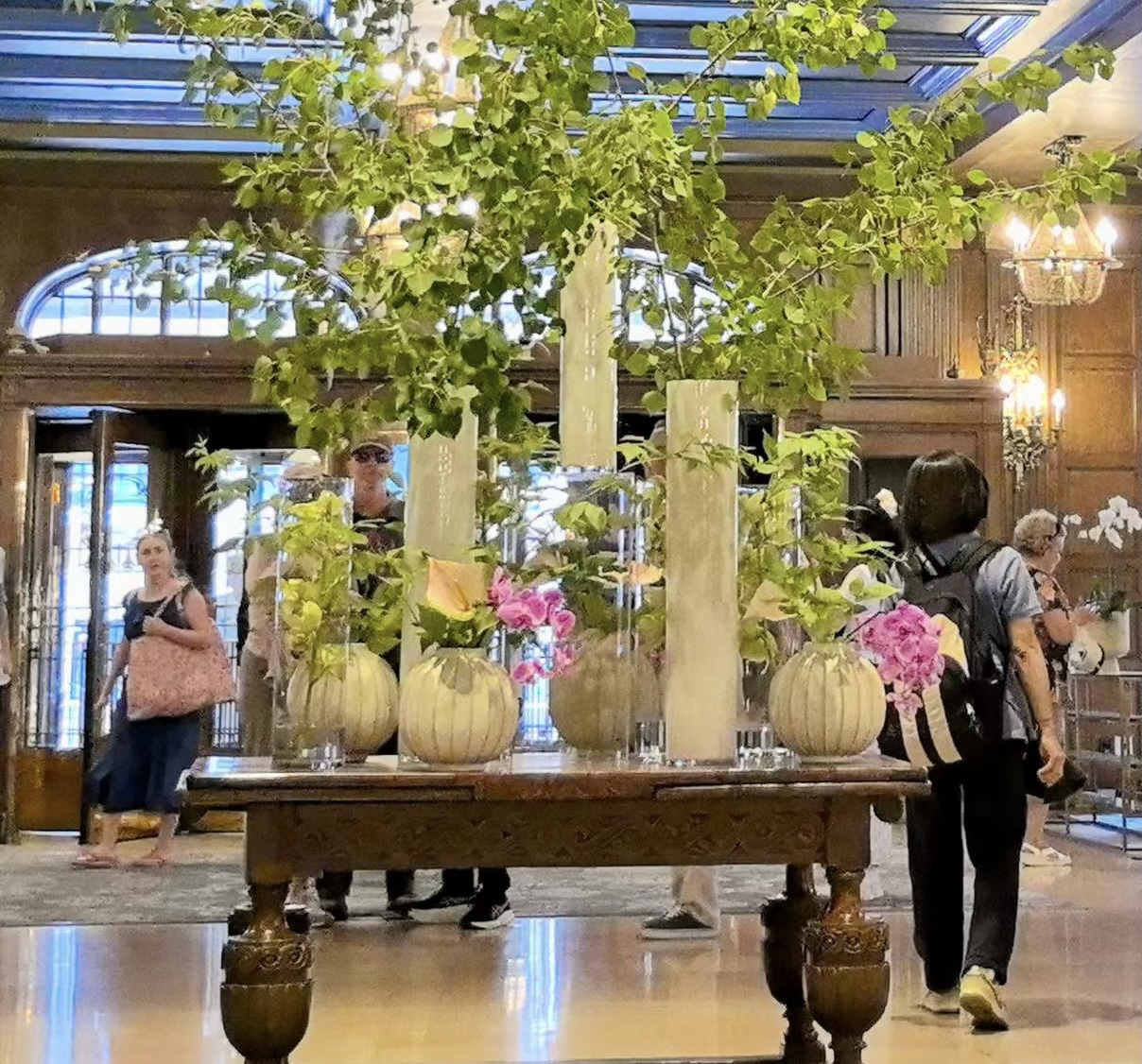
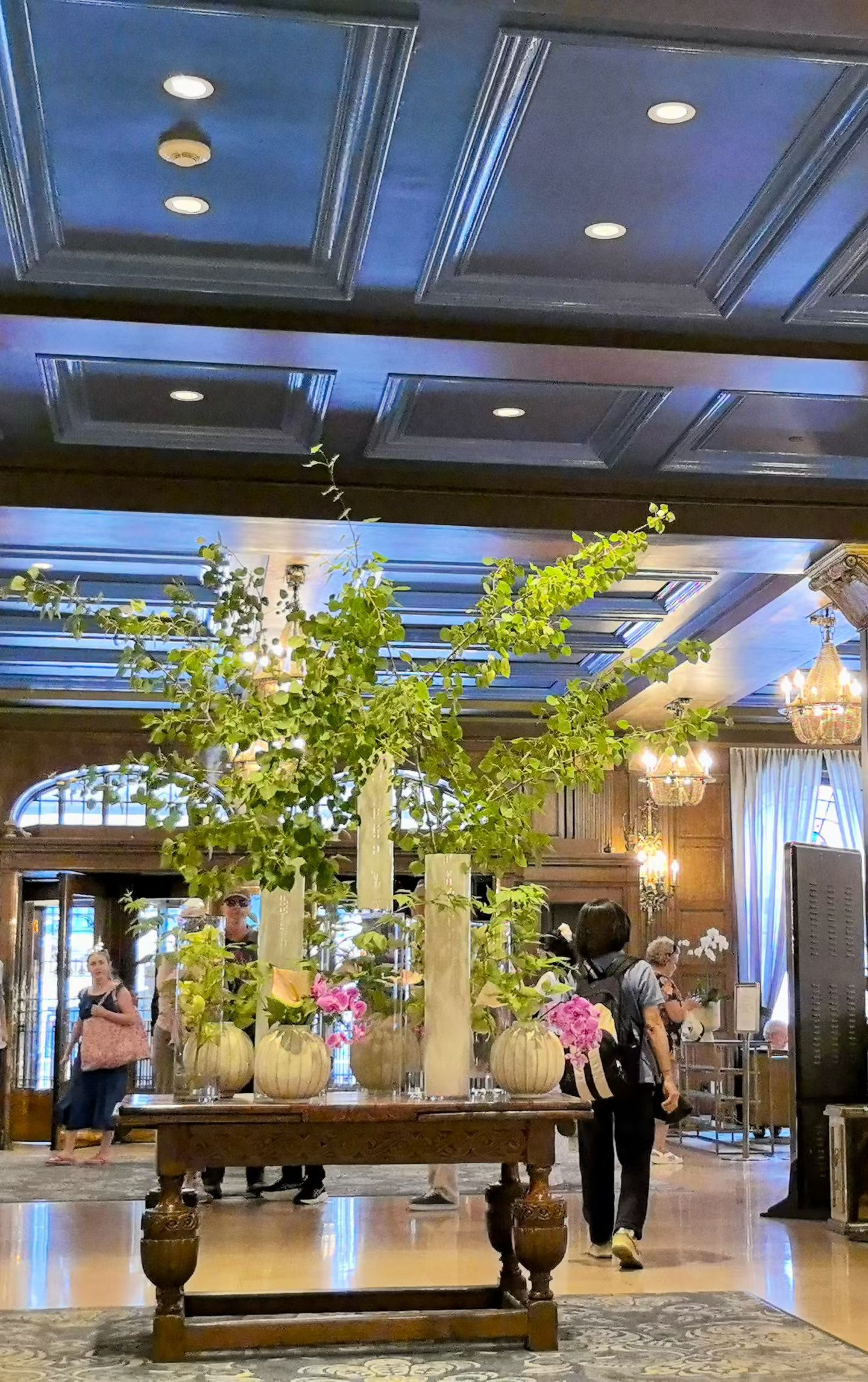
We are, by temperament, seekers of beauty. Standing there, we wondered: what if the royal blue coffered ceiling entered the frame? Tilt the camera up, and the composition gains a three-color chord spanning the full vertical depth of the room — blue overhead, green in the branches, red-pink in the blossoms — with the chandeliers and receding beams supplying perspective (Figure 2). These are the additive primaries of light, the very channels a camera records, and they produce the strongest possible contrast of hue [4]. Josef Albers's principle applies here with particular force: a color is never seen as it physically is, but always in relation to the colors beside it [5]. The blue ceiling does not merely accompany the green branches and pink blossoms; it changes them.
The original floral designer almost certainly did not intend to harmonize the arrangement with the architecture above. That is precisely the point: the interpretation and the framing gave it a new life.
The theory behind it
Several established concepts describe what is happening here.
The first is site-specificity: the idea that a work's meaning is inseparable from its location. Richard Serra put it uncompromisingly when the U.S. government proposed relocating his sculpture Tilted Arc from Federal Plaza: "To remove the work is to destroy the work" [6]. He also described what surroundings do to perception — as the viewer moves, the sculpture changes, and so does the reading of the entire environment [7]. Muralists working in trompe l'œil, such as Richard Haas, extend this logic outward, transforming blank building facades into architectural illusions that engage directly with the existing streetscape [8].
The second concept, and the one closer to what we did with the ceiling, is borrowed scenery — jiejing (借景) in Chinese, shakkei in Japanese. The term originates in the Ming-dynasty garden treatise Yuanye (园冶, The Craft of Gardens, c. 1631) by Ji Cheng, whose final chapter is titled "Jiejing." It describes incorporating an outside view into a garden's composition so that distant elements become integral to the experience of the place [9]. Scholars note that for Ji Cheng, borrowing was not a mere technique but the essence of the entire design philosophy [10]. A garden borrows a mountain it does not own. A photograph borrows a ceiling the florist never considered.
Walter Benjamin's notion of aura — the authority a work draws from its unique presence in a particular place and time — belongs in the same conversation [11]. So does Gestalt psychology, which holds that the mind perceives a composition as a whole rather than as an assembly of parts. As Kurt Koffka put it, the whole is other than the sum of its parts [12] — not simply larger, but different in kind. The interaction between a work and its environment produces an aesthetic reality that neither possesses alone.
Art built for its surroundings
Some works are conceived this way from the start. Mural painting is the obvious case: the Mexican muralists Diego Rivera and José Clemente Orozco made walls, not pictures. Orozco's The Epic of American Civilization was painted into the basement of Dartmouth's Baker Library and cannot be separated from it [13]. Ceilings have their own tradition, from Michelangelo's Sistine vault to Andrea Pozzo's quadratura, which dissolves the roof of Sant'Ignazio into painted sky. In our own era, Robert Smithson's Spiral Jetty changes with the water level of the Great Salt Lake, and Andy Goldsworthy builds work entirely from the materials of a particular landscape, letting weather complete and then erase it [14]. James Turrell's Skyspaces go furthest in the direction of our Frontenac photograph: they are rooms with an aperture cut in the ceiling, in which the framed sky itself becomes the artwork.
Why this matters in the age of AI
In our current era of artificial intelligence, an artistic presentation harmonized with its physical surroundings reveals something that generative models do not possess. A generative model can synthesize a spectacular standalone image from statistical patterns; what it cannot do is stand in a room.
The distinction is that a generated image is made, while a photograph like this one is encountered. Roland Barthes located photography's peculiar power in its indexical link to reality: the thing was there, before the lens, at that moment [15]. Our Frontenac image records a real ceiling, a real arrangement, a real afternoon — and, crucially, a decision made by two people standing in that room, choosing where to stand and how much of the world to admit into the frame. The same arrangement, borrowed against a different ceiling, a different hour, a different light, would yield a different work with a different meaning.
What environment-blended art offers, then, is not something AI is technically incapable of rendering, but something it does not have: situation. Presence in a place. The perpetual renewal that comes from a world that refuses to hold still.
References
- Dewey, John. Art as Experience. New York: Minton, Balch & Company, 1934, pp. 3–15. Reprinted in The Later Works of John Dewey, 1925–1953, ed. Jo Ann Boydston. Carbondale: Southern Illinois University Press, 1987.
- Duchamp, Marcel. "The Creative Act." Lecture, Convention of the American Federation of Arts, Houston, April 1957; published in ARTnews 56, no. 4 (Summer 1957): 28–29. Reprinted in The Writings of Marcel Duchamp, ed. Sanouillet & Peterson. New York: Da Capo, 1973, p. 140.
- Gombrich, E. H. Art and Illusion: A Study in the Psychology of Pictorial Representation. Princeton: Princeton University Press, 1960.
- Itten, Johannes. The Art of Color: The Subjective Experience and Objective Rationale of Color. Trans. Ernst van Haagen. New York: Reinhold, 1961.
- Albers, Josef. Interaction of Color. New Haven: Yale University Press, 1963.
- Serra, Richard, testimony at GSA public hearing, 1985; see Weyergraf-Serra & Buskirk, eds., The Destruction of Tilted Arc: Documents. Cambridge, MA: MIT Press, 1991.
- Serra, Richard, on viewer movement and the perception of environment; see The Destruction of Tilted Arc: Documents, and Kwon, Miwon, One Place After Another: Site-Specific Art and Locational Identity. Cambridge, MA: MIT Press, 2002.
- Haas, Richard. Richard Haas: An Architecture of Illusion. New York: Rizzoli, 1981.
- Ji Cheng 计成. Yuanye 园冶 (The Craft of Gardens), c. 1631; trans. Alison Hardie. New Haven: Yale University Press, 1988.
- Kuitert, Wybe. "Borrowing Scenery and the Landscape that Lends — The Final Chapter of Yuanye." Journal of Landscape Architecture 10, no. 2 (2015): 32–43.
- Benjamin, Walter. "The Work of Art in the Age of Mechanical Reproduction," 1935.
- Koffka, Kurt. Principles of Gestalt Psychology. New York: Harcourt, Brace, 1935. Reprinted London: Routledge, 1999.
- Orozco, José Clemente. The Epic of American Civilization, 1932–34. Baker Library, Dartmouth College (a National Historic Landmark).
- Goldsworthy, Andy. A Collaboration with Nature. New York: Harry N. Abrams, 1990.
- Barthes, Roland. Camera Lucida: Reflections on Photography, 1980.