
Modern Smartphone Camera Zooms
Three lenses, eight “pro lenses” — how the iPhone 17 Pro pulls it off
Modern smartphone camera specifications make a fascinating claim: optical-quality zoom delivered by a handful of rear cameras, including “in-between” focal lengths that also perform at optical quality. How do smartphone cameras pull this off? Let's dive into the details, using the iPhone 17 Pro and Pro Max as our example.
1. The physical lenses behind the zoom
First, let's look at the physical hardware anchoring those zoom stops. The iPhone 17 Pro has three rear cameras, and the Pro and Pro Max share an identical camera system: [1, 2]
- Ultra Wide camera: 48 MP sensor with a 13 mm equivalent focal length and an ƒ/2.2 aperture. It uses a 1/2.55-inch sensor with 0.7 µm pixels.
- Main (Wide) camera: 48 MP sensor with a 24 mm equivalent focal length and an ƒ/1.78 aperture. It uses a 1/1.28-inch sensor with 1.22 µm pixels.
- Telephoto camera: 48 MP sensor with a 100 mm equivalent focal length and an ƒ/2.8 aperture. It uses a 1/2.55-inch sensor with 0.7 µm pixels, behind a “tetraprism” folded-lens design that provides 4x optical zoom relative to the main camera.
When we talk about zoom factors on a smartphone, the main camera defines 1x — here, the 48 MP sensor behind the 24 mm equivalent lens. So:
24 mm × 4 = 96 mm ≈ 100 mm
This is called 4x optical zoom because it provides four times the equivalent focal length of the 1x main camera. The important word is equivalent: the 4x describes a ratio against the main camera on the same phone, not a lens that changes its own focal length.
The values 13, 24 and 100 mm are also 35 mm-equivalent figures, not physical focal lengths. The main camera's actual focal length is about 6.9 mm; it only behaves like a 24 mm lens because its sensor measures roughly 9.8 × 7.3 mm instead of the 36 × 24 mm of a full-frame camera. [3] The equivalent number is the honest way to describe angle of view across wildly different sensor sizes, and it is why “24 mm” on a phone and “24 mm” on a full-frame camera frame the same scene.
So “equivalent” is the key to understanding smartphone zoom. Not every stop is a true optical zoom, but several of them deliver optical-quality results — and the reasons why are more interesting than the marketing.
2. How the 0.5x / 1x / 1.2x / 1.5x / 2x / 4x / 8x stops are achieved
Apple advertises the system as the equivalent of eight “pro lenses,” even though there are physically only three rear camera modules. That count comes from seven zoom stops plus macro:
| Zoom | Equivalent focal length | Source |
|---|---|---|
| 0.5x | 13 mm | True optical Ultra Wide camera |
| 1x | 24 mm | True optical main camera |
| 1.2x | 28 mm | Main camera crop |
| 1.5x | 35 mm | Main camera crop |
| 2x | 48 mm | 2x central crop of the main sensor |
| 4x | 100 mm | True optical telephoto camera |
| 8x | 200 mm | 2x central crop of the telephoto sensor |
Apple's own summary is “8x optical-quality zoom in, 2x optical zoom out; 16x optical-quality zoom range.” [1] Note the careful wording: the 2x and 8x stops are labeled optical-quality, not optical — the company conceding in its own spec sheet that these are sensor crops rather than lenses. [4]
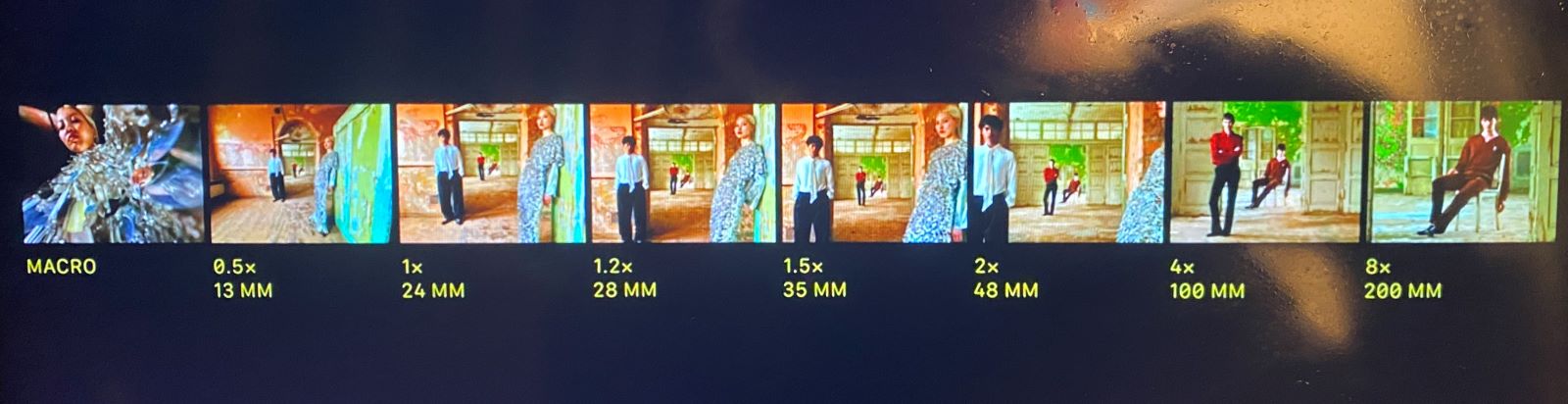
0.5x, 13 mm
This comes from the true optical Ultra Wide camera; going from 1x to 0.5x physically switches from the main module to the Ultra Wide. With an ƒ/2.2 aperture (versus the main camera's ƒ/1.78) and much smaller pixels, it gathers less photons, so it will be noisier in low light than the main camera.
1x, 24 mm
This is the true optical main camera. It has both the widest aperture and the largest pixels of the three rear cameras, so it collects the most photons. That is why most photography is best done on the main camera, especially in low light or at night.
1.2x, 28 mm and 1.5x, 35 mm
Both come from crops of the main camera, as illustrated in Figure 2. [4] Neither lands on a clean divisor: 28 ÷ 24 = 1.167 and 35 ÷ 24 = 1.458. Neither crop maps to a native output resolution, so the pipeline crops from the 48 MP read and rescales to the 24 MP output.
So why offer 1.2x and 1.5x at all? Apple added them as selectable default focal lengths because 28 mm and 35 mm are the classic reportage framings that photographers actually want.
Instead of switching lenses, the phone exploits the large pixel count of the 48 MP main sensor and simply crops toward the center. Because the sensor has so much resolution in reserve, the crop behaves much like an optical zoom, with little or no loss of detail.
The arithmetic shows exactly how little. A 24 MP output is half the pixel count of a 48 MP sensor, so each dimension shrinks by √2 ≈ 1.414. Since 28/24 = 1.167 < 1.414 < 35/24 = 1.458, the 28 mm crop region is still wider than the 24 MP output — a downscale that keeps genuine detail, arguably making it the best-looking stop on the phone. At 35 mm the crop is marginally narrower than the output, so there is a slight upscale. In practice the difference may be invisible, but it shows that the camera's ISP and computational photography are doing work underneath rather than delivering pure native optical output.
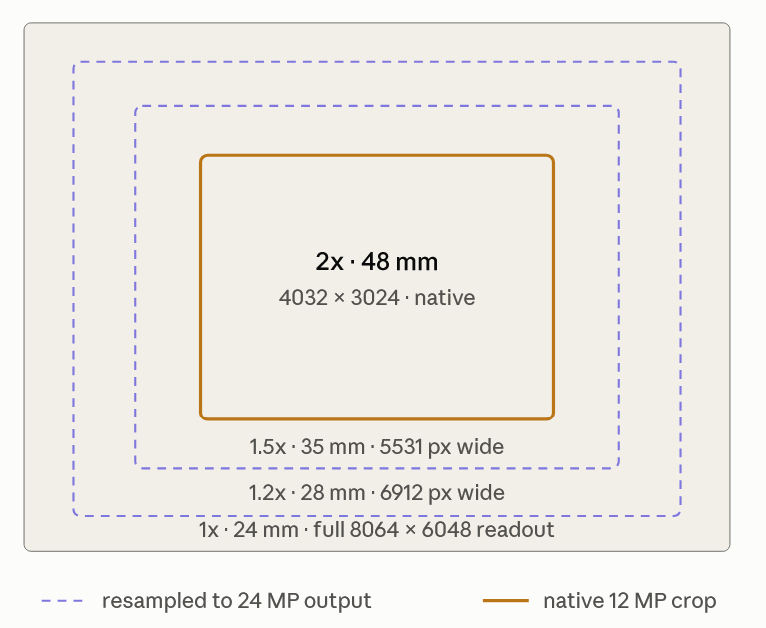
2x, 48 mm
This is a 2x central crop of the main sensor. Because that sensor is a quad-Bayer array (2×2 same-color pixel groups), the 2x crop is a special case, and it is worth walking through in detail.
48 mm is exactly twice 24 mm, so the crop is exactly half the sensor's width and half its height. On an 8064 × 6048 array, that is a 4032 × 3024 center region — precisely 12 MP. Apple outputs 12 MP at 2x, so every output pixel maps to one photosite/pixel on the sensor. This is why Apple can call 2x “optical quality” without stretching the truth.
In the default 24 mm mode, the pipeline bins each 2×2 group into one effective large pixel for a better signal-to-noise ratio (SNR), then fuses that with a full-resolution read to recover detail. At 2x, it instead reads the center region at full resolution and demosaics it directly.
There is a real ISP cost here. At full resolution the color filter array is not a standard Bayer pattern, so the pipeline must remosaic — rearrange the quad-Bayer samples into a Bayer-equivalent grid before conventional demosaicing — or use a demosaic algorithm built for quad-Bayer directly. Done badly, this produces false color and maze artifacts in fine textures. Done well, it comes very close to a true 12 MP capture. Critically, the 2×2 binning is lost, so per-pixel SNR drops by roughly a factor of √4 = 2, or about 6 dB. That is the hidden tax on 2x: the same framing as a real 48 mm lens, but noticeably noisier in dim light.
4x, 100 mm
100 mm (4x) is the telephoto module's native field of view — a real physical lens, folded through a tetraprism so that a long optical path fits inside a thin body. With much smaller pixels and a narrower aperture, it collects far less photons than the main camera, so its images are generally somewhat noisier. But it is a real optical camera, and that makes it fundamentally different from the 48 mm crop: for a distant subject, the 100 mm camera resolves detail that would simply be lost if you cropped the 24 mm camera to the same framing.
8x, 200 mm
This is a 2x central crop of the telephoto sensor — the same maneuver that produces 48 mm from the main camera. Applied to the telephoto's 48 MP sensor, it yields exactly 4032 × 3024, or exactly 12 MP, natively. [1]
Beyond 8x, up to the 40x maximum, there is nothing left to crop. That range is pure digital upscaling, increasingly driven by machine-learning-based computational photography. [1]
3. Macro deserves a special mention
Macro is not a zoom stop at all. It is the Ultra Wide camera — which has autofocus — racked to its minimum focus distance and then cropped. It sits at the left end of the zoom strip, to the left of 0.5x, but it is a focus-distance mode, not a field-of-view mode.
Macro is also not tied to a single framing: the close-focus capability works alongside the zoom control rather than replacing it. If macro were just another zoom stop, choosing it would mean giving up a field of view, the way choosing 4x means giving up 2x. Macro and zoom are really two separate axes, and the interface flattens them onto one strip because a single horizontal control is easier to use than a two-dimensional one.
The switch is also largely automatic. Apple's own instructions are simply to get as close as 2 cm to the subject, at which point the camera automatically switches to the Ultra Wide camera for macro photography. [5] The trigger is subject distance, not a framing decision you made, so the macro control is more of an override on automatic behavior than a choice from a list.
When 2x crops the main sensor, the crop is the whole point — you want a narrower angle of view, and the crop delivers it. When macro crops the Ultra Wide, the crop is damage control, for two reasons:
- At a 2 cm working distance [5], a 13 mm-equivalent field of view would frame an enormous area around a tiny subject, and the phone body itself starts to intrude. Cropping to roughly 1x framing gives usable magnification of the thing you are actually pointing at.
- Ultra wide lenses at extreme close focus have poor corner performance — field curvature and astigmatism grow rapidly as the lens focuses closer. Cropping to the center throws away the worst of it.
So the crop compensates for having been forced onto the wrong lens, rather than delivering a requested framing.
There is a deeper reason macro resists a focal-length label. Equivalent focal length describes angle of view at infinity focus. It is a convenient proxy that lets you compare a 6.9 mm phone lens with a 24 mm full-frame lens. At macro distances that proxy breaks down: the lens extends, the effective focal length shifts, the angular field narrows, and what actually matters becomes magnification — the size of the subject's image on the sensor divided by the subject's real size — together with working distance. Nobody buying a macro lens asks about its angle of view; they ask about its reproduction ratio.
So describing macro as “13 mm cropped” is true about which physical lens the light passed through, but it does not tell you what you would want to know about a macro shot. There is a nice piece of evidence for this in the screenshot itself: every other stop in the strip carries a millimeter value beneath it. MACRO does not. Apple's own interface declined to assign it a focal length, which suggests their team drew the same line.
This is the key distinction: zoom determines field of view, while macro concerns focusing distance and magnification. The two are related, but they are not the same concept.
A related point: even if you explicitly select a macro mode — such as “Super Macro” on Huawei Mate Pro phones — and then photograph a distant scene, the phone still produces an image, but it is no longer a macro photograph in any meaningful sense (Figure 3). The mode name describes a focusing regime, not a property of the resulting picture.

4. What about the “in-between” zooms?
When you pinch to an arbitrary value such as 0.8x or 3.2x, the phone has neither a clean sensor crop nor a physical lens matching that focal length. This is where the software does the heavy lifting, likely through some combination of:
- Image fusion: The phone may capture from two cameras at once — the 0.5x and the 1x for something like 0.8x — and merge the results. In low light it may instead use the main camera with some scaling rather than the Ultra Wide, whose smaller pixels and slower aperture would cost more in noise than the rescaling costs in detail.
- Computational photography: Where fusion alone is not enough, machine-learning-based algorithms beyond the traditional ISP pipeline step in to refine the result.
Apple does not fully document which cameras are used or combined at each intermediate setting, and the behavior can change with lighting, focus distance and other conditions. The descriptions above should therefore be read as informed analysis rather than confirmed specifications.
What is documented is the hardware asymmetry underneath: the 0.5x and 4x cameras are not the equal of the 1x camera. Even though all three are 48 MP, the Ultra Wide and telephoto sensors are physically smaller and sit behind slower lenses, so 0.5x and 4x have meaningfully worse low-light performance than 1x. Equal megapixel counts across modules hide very unequal light/photons collection.
Conclusion
The iPhone 17 Pro and Pro Max point to an important direction in smartphone photography: three physical camera modules can provide a much wider range of useful focal lengths when optical lenses, high-resolution sensors, cropping and computational photography work together.
The three physical cameras are:
13 mm Ultra Wide · 24 mm Main · 100 mm Telephoto
From these, the phone derives four additional focal lengths — plus macro, which is a focusing mode rather than a focal length:
28 mm · 35 mm · 48 mm · 200 mm
None of these additional focal lengths is a separate physical lens. They rely on high-resolution sensor crops and computational processing to deliver useful image quality at different fields of view.
That is why Apple's term “optical-quality” matters. It does not mean that every advertised focal length comes from its own optical lens; it describes the image quality Apple believes the combination of optics, sensors and processing can achieve. The result is a camera system with only three physical rear modules that can behave, from the photographer's perspective, like a much larger collection of lenses.
References
- Apple, “iPhone 17 Pro — Technical Specifications” and “iPhone 17 Pro Max — Technical Specifications”, Apple Support (accessed September 2026). Source for the 13 / 24 / 100 mm equivalent focal lengths, apertures, tetraprism design, 40x digital zoom, and the “8x optical-quality zoom in, 2x optical zoom out; 16x optical-quality zoom range” claim.
- GSMArena, “Apple iPhone 17 Pro review: Camera, photo and video quality”. Source for sensor optical formats and pixel pitches (1/1.28-inch, 1.22 µm main; 1/2.55-inch, 0.7 µm Ultra Wide and telephoto). Sensor supplier and part numbers corroborated by Smartprix, “iPhone 17 Series Camera Sensors Revealed: All Of Them Are From Sony”.
- Apple does not publish physical focal lengths; the value is recorded in each photo's EXIF metadata. It is consistent with the sensor geometry: a sensor diagonal of about 12.2 mm against the 43.3 mm full-frame diagonal gives a crop factor of about 3.5, and 24 ÷ 3.5 ≈ 6.8 mm, in line with the roughly 6.8–6.9 mm EXIF values reported for recent iPhone Pro main cameras. See Adobe Community, “Lens profiles for iPhone 15 Pro Max main back camera fail due to mismatching focal lengths”.
- Moment, “iPhone 17 Camera Lenses (Explained)”. Confirms which zoom stops are physical lenses (13, 24 and 100 mm) and which are digital crops (28, 35, 48 and 200 mm, and macro).
- Apple, “Take macro photos and videos with your iPhone camera”, Apple Support. “Get close to the subject—as close as 2 centimeters. Camera will automatically switch to the Ultra Wide camera to enable macro photography.”
Further reading: DXOMARK, “Apple iPhone 17 Pro Camera test” — lab measurements showing where detail drops as the phone crops deeper into the main sensor before the telephoto module takes over.
Enjoyed this post? ☕ Buy me a coffee